
Guide · checked November 2026
Clinical audit sample size: how many cases do you need?
For a clinical audit you want to generalise from, HQIP's table gives the cases needed for ±5% accuracy: at 95% confidence that is every case when there are fewer than 30, 79 of 100, 217 of 500 and 278 of 1,000; with a small population, or data you can read electronically, auditing every case is often simpler.
Do you need a sample at all?
HQIP's data quality guide asks two questions: how many cases would clinicians need to see before they act on the findings, and do you want to generalise from a sample to the whole population? If you do, the sample has to be representative and large enough. HQIP's best practice criteria add that the rationale for the sample size and selection method should be written down.
HQIP's table
Appendix 1 of HQIP's guide to analysing improvement data gives recommended sample sizes for ±5% accuracy. It assumes the thing you are measuring happens about half the time and the answer is yes or no. Population, then cases at 90%, 95% and 99% confidence:
- Fewer than 30: all cases.
- 50: 42, 44, 47.
- 100: 73, 79, 87.
- 200: 115, 132, 154.
- 500: 176, 217, 286.
- 1,000: 213, 278, 400.
- 5,000: 257, 357, 587.
Where an audit has several standards with different expected rates, HQIP suggests using the largest recommended size, because it covers all of them.
The formula
For 95% confidence and ±5% accuracy, HQIP's formula is: sample size = (1.96² × N × p(1 − p)) ÷ ((0.05² × N) + (1.96² × p(1 − p))), where N is the population and p the proportion you expect. Use 1.645 instead of 1.96 for 90% confidence, or 2.58 for 99%.
Report the result as a range. HQIP's example: with 84% compliance and a sample sized for 95% confidence and ±5%, you can say you are 95% confident the true value lies between 79% and 89%. Its report template gives a worked case: 143 procedures in a year, of which 105 were needed for that level of confidence.
Choosing the cases
- Simple random: every case has an equal chance; HQIP's guide shows how to do it in Excel.
- Systematic: every nth case after a random start, for example every 15th of 1,500 to get 100.
- Stratified: sample within groups such as wards or staff groups, in proportion or deliberately weighted.
- Cluster: pick whole groups at random, cheaper but less accurate.
- Purposive and convenience samples are not representative. HQIP notes that a quick "snapshot" can be a convenience sample, with a high risk of bias.
When cases go missing
HQIP's data quality guide says the protocol should cover missing cases, records that cannot be retrieved in time, cases that turn out not to meet the inclusion criteria, and what to do if the target number cannot be reached. Adding extra cases to replace hard-to-find ones can bias the result; one or two may be acceptable. HQIP also advises against percentages when the sample is small, for example under 20.
Some audits have a fixed minimum. NHS England Digital's DSPT guidance sets clinical coding audits at acute trusts at a minimum of 200 episodes a year (or 2% if smaller) and 50 at mental health trusts.
Sampling myths
- "Ten per cent of cases" is not a rule: the table shows the number needed levels off as the population grows.
- "The notes we could find" is a convenience sample, not a random one.
- Breaking results down by ward or consultant shrinks each group's sample; plan that granularity before you collect.
Where Oriel fits
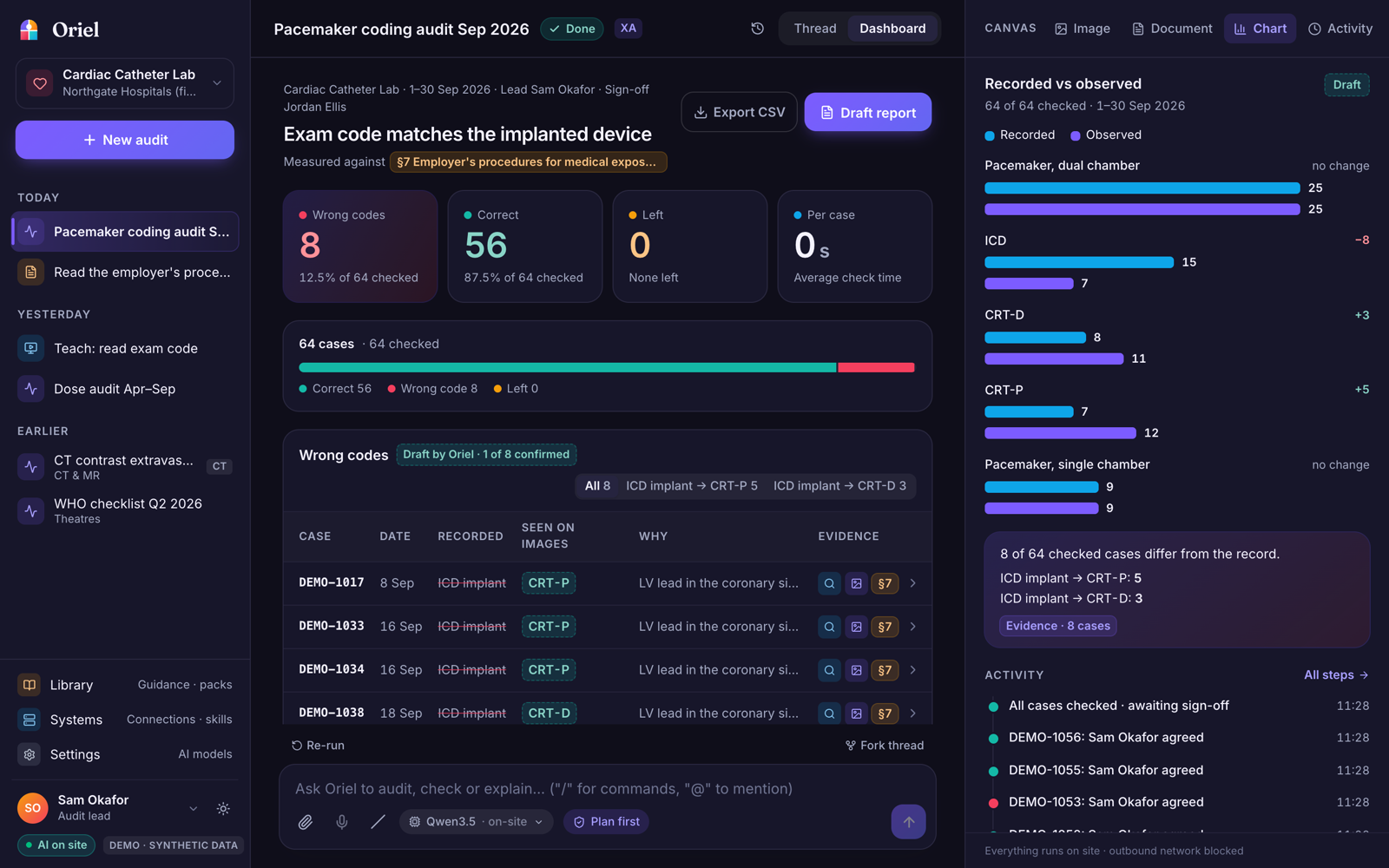
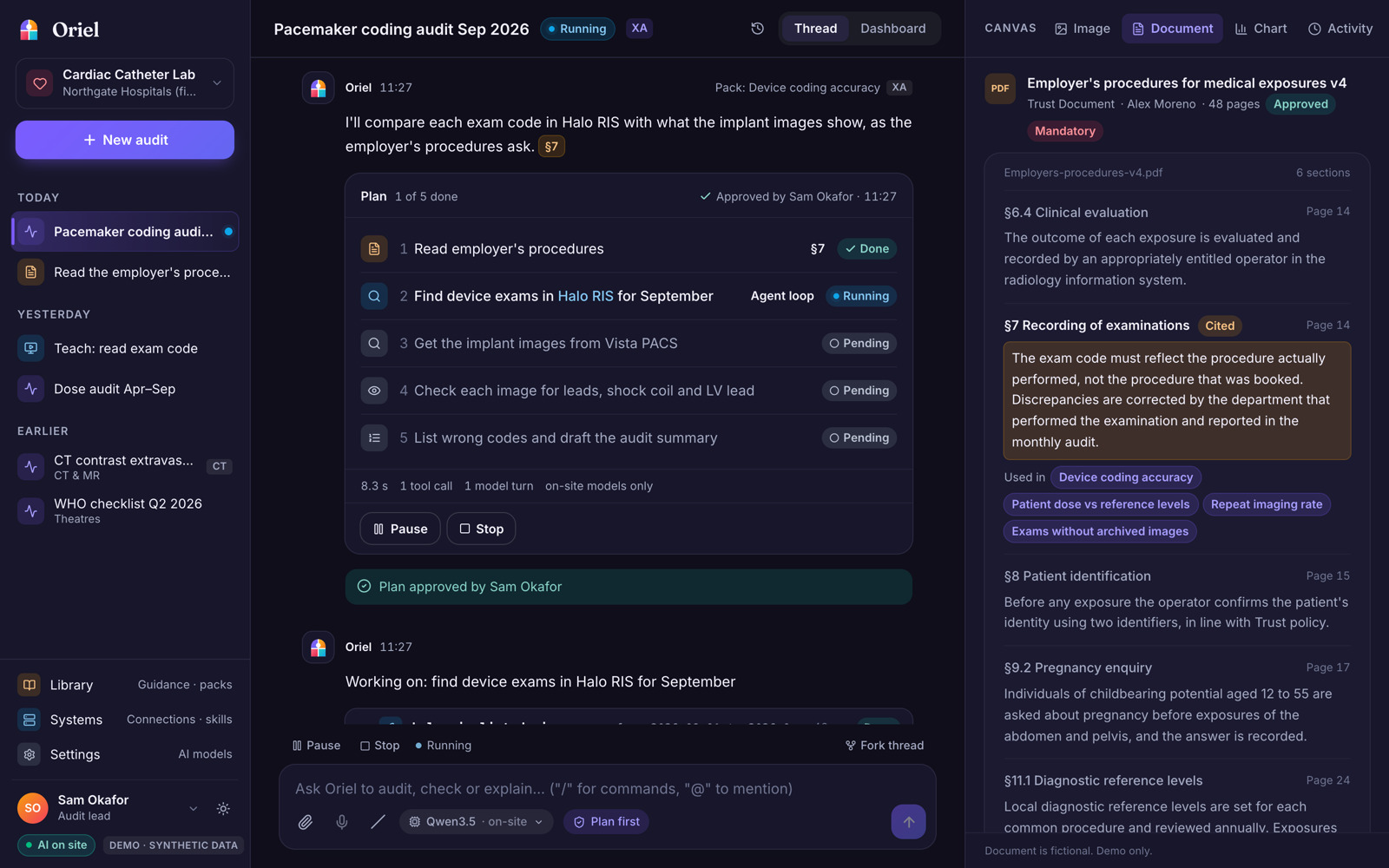
Oriel checks every case in the audit period rather than a sample, reading from connected systems or an imported CSV or XLSX file, so the denominator is the whole population. You still define the population and exclusions in the pack, and unclear cases wait for a person to decide rather than being dropped.
Where records are not electronic, sampling still applies. Oriel is a pilot shown on synthetic data only and is not a medical device.
 Oriel: On-premises AI clinical auditWatch the demo on synthetic data, then see how it works →
Questions
Is 30 cases enough for a clinical audit?
It depends on the population. HQIP's table says audit all cases when there are fewer than 30; for 100 eligible cases it recommends 79 at 95% confidence and ±5%.
Do I need a significance test?
Audit compares practice with a standard. HQIP asks for statistics that fit the purpose and give the clearest picture of performance, such as compliance with a confidence range.
Should I just audit every case?
If the population is small or the data can be read electronically, often yes. It removes sampling error, though the method still needs writing down.
Sources
Official pages, checked November 2026. Guidance changes, so check the current version before you rely on it.
- HQIP: An introduction to analysing quality improvement and assurance data (October 2018)
- HQIP: Guide to ensuring data quality in clinical audits
- HQIP: Best practice in clinical audit (April 2020)
- HQIP: Documenting local clinical audit, a guide to reporting and recording (April 2020)
- NHS England Digital: DSPT assessment guide 1.1, clinical coding (1.1.7 to 1.1.8)
General information for healthcare managers and clinical teams, checked November 2026. It is not legal, regulatory or clinical advice; follow the current official guidance and your organisation's own policies. No patient data is used in these examples. Oriel is a working prototype shown on a fictional demo hospital with synthetic data only. It is not a medical device and is not for clinical use. It drafts and flags for people to decide; it does not diagnose or change clinical records. A clinical safety case and information-governance approval come before any use with real patient data. Oriel is a working name.