
Guide · checked November 2026
Clinical coding audit: what it involves and where automation helps
A clinical coding audit checks that the ICD-10 and OPCS-4 codes assigned to hospital episodes match the patient record and national coding standards; in England, acute and mental health trusts have them carried out by NHS England approved clinical coding auditors using the Terminology and Classifications Delivery Service methodology, and report through the Data Security and Protection Toolkit.
What the DSPT expects
In the Data Security and Protection Toolkit (DSPT), contributing outcome E4.b asks organisations to show they regularly evaluate and improve their coded clinical data. NHS England Digital's guidance says acute and mental health trusts have established procedures for regular quality inspections of coded data for inpatient and day case episodes, carried out by approved clinical coding auditors using the latest version of the Terminology and Classifications Delivery Service (TCDS) Clinical Coding Audit Methodology.
Its guide for independent assessors suggests inspecting the clinical coding policy, evidence that coding practice follows it, clinical coding audit documentation and coding staff training records.
The numbers
- Acute trusts: audits totalling at least 200 episodes over the year (or 2% if smaller), as one audit or a series of smaller ones.
- Mental health trusts: at least 50 episodes.
- A coding audit programme within the 12 months before the DSPT submission.
- Acute trust accuracy, standards met: primary diagnosis 90%, secondary diagnosis 80%, primary procedure 90%, secondary procedure 80%.
- Acute trust accuracy, standards exceeded: 95%, 90%, 95% and 90%.
- Mental health trust accuracy, standards met: 85%, 75%, 85% and 75%; exceeded: 90%, 80%, 90% and 80%.
- All four areas must reach the level to attain it.
The guidance adds that these are minimums: each organisation should decide a meaningful number of episodes across its sites and specialties.
What the auditor looks at
The methodology analyses primary and secondary diagnosis and procedure codes for correct and incorrect codes, incorrect sequencing, and irrelevant or omitted codes. It also examines the coding process and the documentation available to coders. The sample may be informed by national benchmarking or previous audits, focused on a specialty, or representative of the organisation's case mix.
The report should separate coder error from non-coder error, such as poor documentation or a process that is not fit for purpose, though both count as inaccuracy. The guidance urges organisations to note that many coding problems come from the information coders are given. Recommendations from earlier audits must be tracked to completion, for example in an action log.
Where automation helps, and where it doesn't
Software can help around the audit: pulling the episode list, putting the coded episode next to the source documents, flagging likely omissions or sequencing problems for a coder or auditor to review, and tracking recommendations. The guidance allows a continuous programme of smaller audits through the year, which suits regular local checks, and mentions third-party benchmarking and coding assurance tools.
It does not replace the formal audit. For the DSPT, the audit must be done by an approved auditor applying the current methodology, with codes judged against the national standards in force when the coding was done.
What a coding audit is not
- An internal spot check is not a DSPT coding audit unless an approved auditor carries it out with the current methodology.
- Not every error is a coder's error: documentation and process problems count too.
- Not a clinical audit: it measures the accuracy of coded data, not care against a clinical standard.
Where Oriel fits
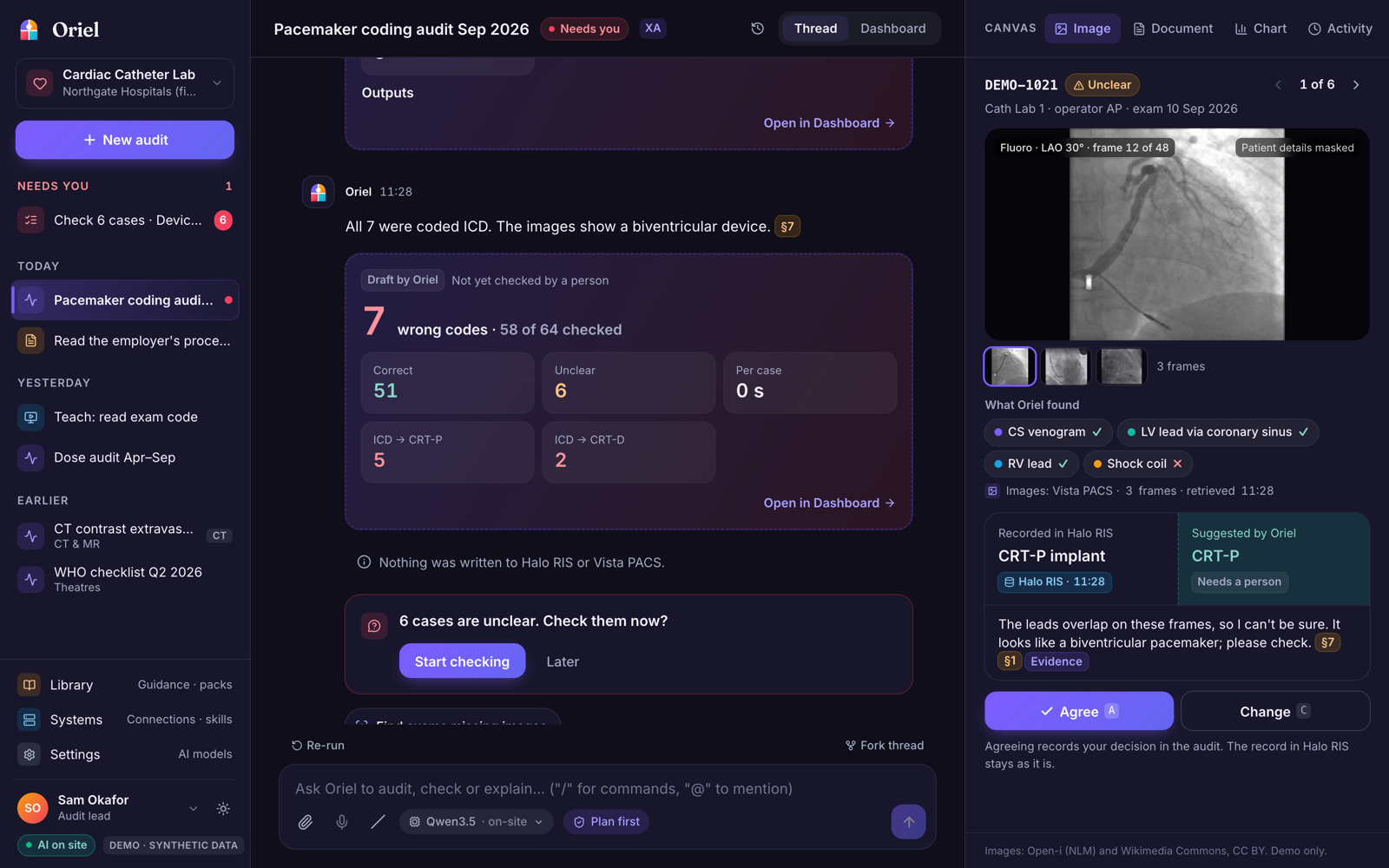
Oriel's first demo pack is a coding check of a different kind: it compares the exam code recorded in a radiology system with what the implant images show, and lists the cases that disagree for a person to decide. The same pattern, a recorded code checked against evidence in another system, is what a local coding pre-check needs.
But Oriel does not apply ICD-10 or OPCS-4 rules, does not use the TCDS methodology and is not a substitute for an approved clinical coding auditor. It never changes a record on its own, and it is a pilot shown on synthetic data only.
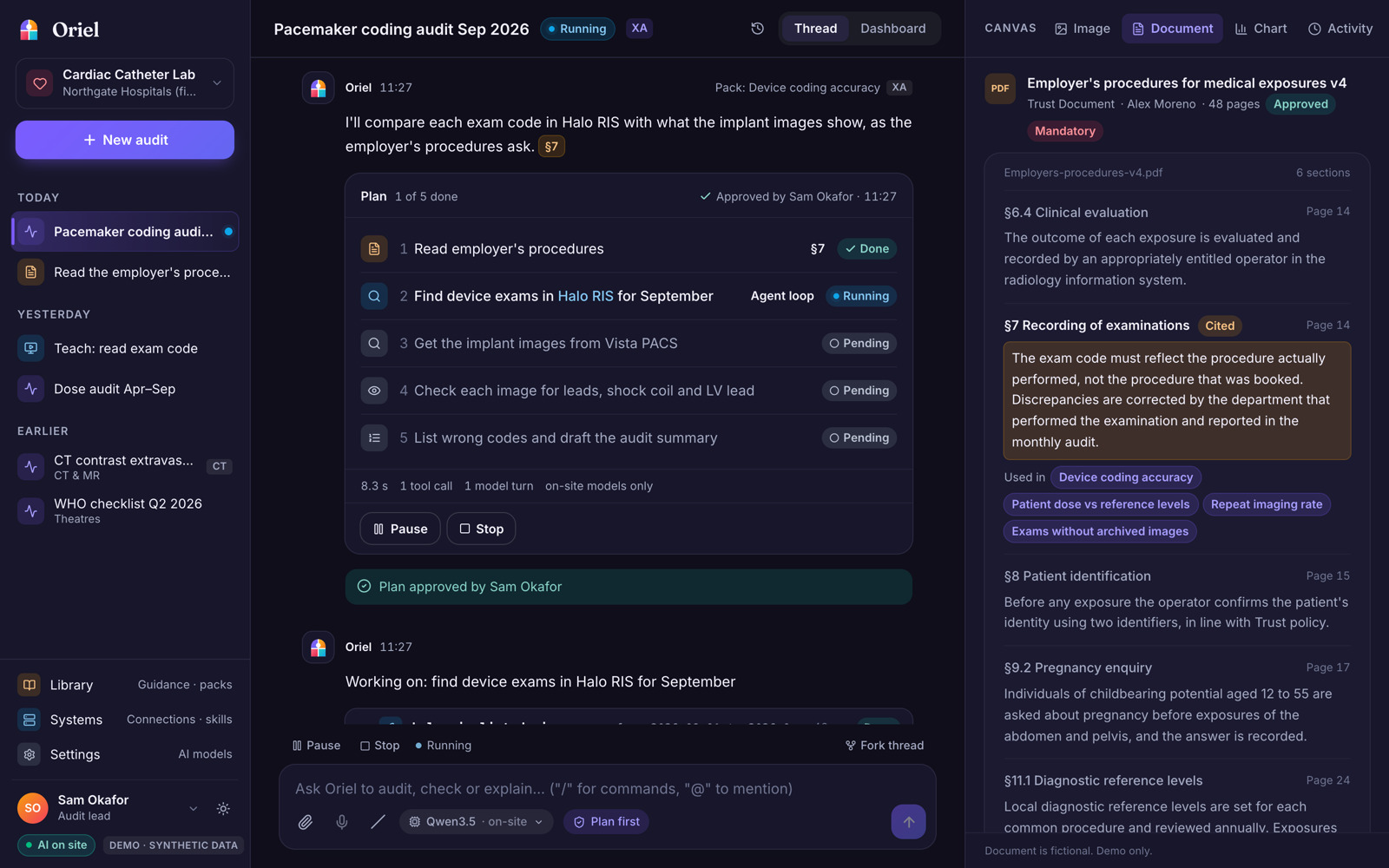 Oriel: On-premises AI clinical auditWatch the demo on synthetic data, then see how it works →
Questions
How many episodes does a clinical coding audit need?
Under the DSPT guidance, at least 200 episodes a year at an acute trust (or 2% if smaller) and at least 50 at a mental health trust.
Who can carry out a DSPT clinical coding audit?
An NHS England approved clinical coding auditor who meets the Clinical Coding Auditor Programme requirements and follows the current TCDS methodology.
What accuracy does an acute trust need?
To meet the standard: 90% for primary diagnosis and primary procedure, and 80% for secondary diagnosis and secondary procedure, in all four areas.
Sources
Official pages, checked November 2026. Guidance changes, so check the current version before you rely on it.
General information for healthcare managers and clinical teams, checked November 2026. It is not legal, regulatory or clinical advice; follow the current official guidance and your organisation's own policies. No patient data is used in these examples. Oriel is a working prototype shown on a fictional demo hospital with synthetic data only. It is not a medical device and is not for clinical use. It drafts and flags for people to decide; it does not diagnose or change clinical records. A clinical safety case and information-governance approval come before any use with real patient data. Oriel is a working name.