
Guide · checked November 2026
Quality improvement vs clinical audit: what's the difference?
Clinical audit is one quality improvement method: it measures care against an agreed standard and acts on the gap, while a quality improvement project (QIP) usually tests changes in small, repeated cycles such as plan-do-study-act; HQIP says audit should be used only when it is the most suitable method.
What HQIP says
HQIP's 2015 guide to quality improvement methods describes twelve methods, including clinical audit, plan-do-study-act (PDSA), the model for improvement, Lean and Six Sigma, performance benchmarking, process mapping, statistical process control and root cause analysis. In its directory, clinical audit is used to check that clinical care meets defined quality standards, while PDSA is used to introduce and test potential improvements on a small scale.
HQIP's Best practice in clinical audit (2020) puts it plainly: audit is one of a range of improvement methods and should not be used if another is more appropriate.
Side by side
- The question: audit asks "do we meet the standard?"; a QIP asks "will this change make things better?"
- The starting point: audit needs an evidence-based standard; a QIP needs a problem and an improvement aim.
- The data: audit measures a defined population or sample over a period, then again after changes; QI usually measures little and often, plotted over time.
- The change: in audit, change follows the first round through an action plan; in QI, testing and adjusting the change is the work itself.
- The governance: HQIP's methods guide says a central register of audits is helpful, while PDSA reviews are usually held ad hoc with the staff in the pathway, though providers may keep them on record.
How they work together
The two are often parts of one piece of work. An audit finds the gap. HQIP's best practice criteria then ask for the underlying causes to be established, and list PDSA cycles, process mapping, communication tools, decision trees, new technology and Lean Six Sigma as ways to design the improvement.
The evidence that closes the audit loop can come from QI work too. HQIP's reporting guide accepts a second round of data collection, a summary of the outcomes of repeated PDSA cycles, or annotated time-series data such as process control charts showing the effect of each change.
Which one to choose
- There is a clear standard and you need to know whether you meet it: clinical audit.
- You already know the gap and want to test fixes quickly: a QI project with PDSA cycles.
- You want to know what a service achieves, with no standard to compare against: service evaluation.
- You are testing a new intervention by allocating people to it, or aiming for knowledge that applies beyond your service: check with the HRA decision tool, as it may be research.
Common confusions
- QI is not a lighter form of audit: it answers a different question.
- A one-off measurement with no change tested is neither a completed audit nor a QIP.
- Neither escapes governance: information governance rules apply to both.
Where Oriel fits
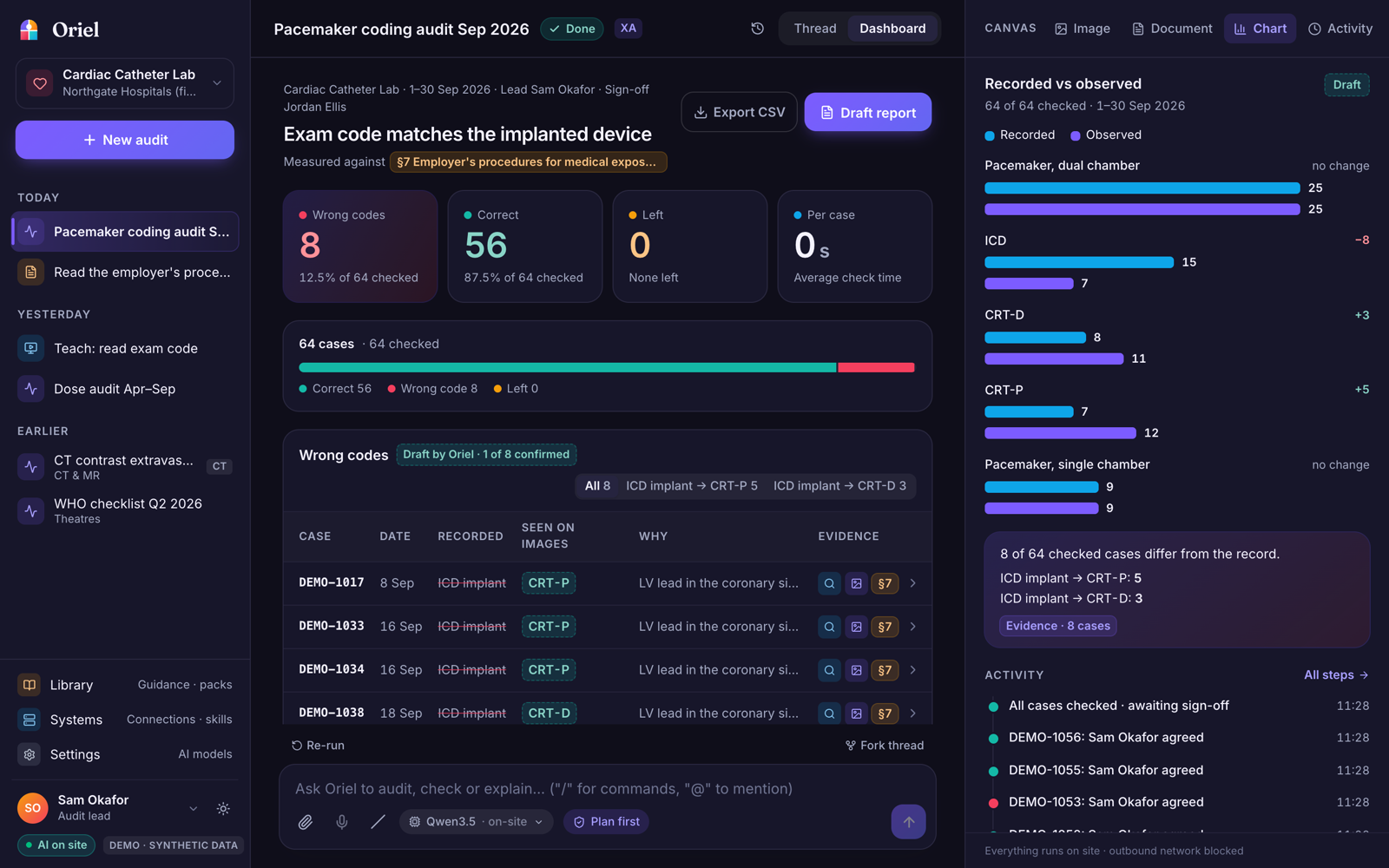
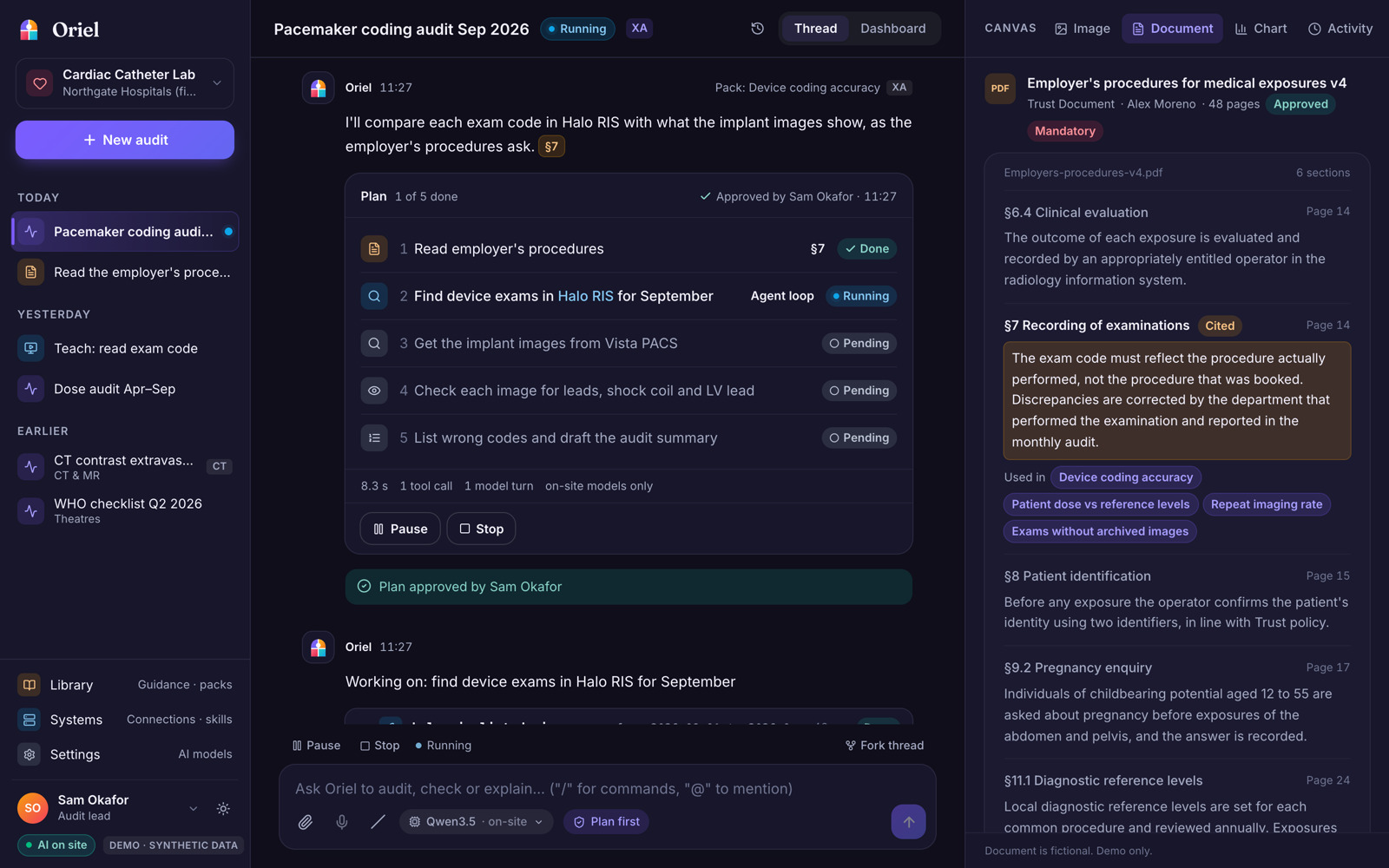
Oriel is built for the measurement side. It checks every case in a period against a rule, keeps the evidence for each one, and asks a named person to decide each finding. Schedules can rerun the same check over a relative period, such as last week or the previous month, and notify people when compliance falls below a level you set, which gives a team regular data points between changes.
Oriel does not plan or manage PDSA cycles. It is a pilot shown on synthetic data only and is not a medical device.
 Oriel: On-premises AI clinical auditWatch the demo on synthetic data, then see how it works →
Questions
Is a QIP the same as a re-audit?
No. A re-audit repeats the same measurement after changes. A QIP tests changes in cycles, though a summary of PDSA cycles can be accepted as evidence that an audit's action plan worked.
Is clinical audit a quality improvement method?
Yes. HQIP defines clinical audit as a quality improvement cycle and lists it among twelve QI methods.
Does a QI project need ethics approval?
Use the HRA's decision tool. Allocating people to a new intervention or aiming for generalisable knowledge can make a project research, which normally needs review.
Sources
Official pages, checked November 2026. Guidance changes, so check the current version before you rely on it.
General information for healthcare managers and clinical teams, checked November 2026. It is not legal, regulatory or clinical advice; follow the current official guidance and your organisation's own policies. No patient data is used in these examples. Oriel is a working prototype shown on a fictional demo hospital with synthetic data only. It is not a medical device and is not for clinical use. It drafts and flags for people to decide; it does not diagnose or change clinical records. A clinical safety case and information-governance approval come before any use with real patient data. Oriel is a working name.