
Guide · checked November 2026
How to write a clinical audit action plan
A clinical audit action plan lists each numbered recommendation with the specific action required, a completion date, a named person responsible, a running status and a change stage; HQIP says it must address the causes of any shortfall, be SMART, and be signed off by the stakeholder group under local governance.

HQIP's template
Appendix 1 of HQIP's Documenting local clinical audit (2020) ends with a clinical audit action plan. The header carries the audit number, the project title (exactly as on the report's front cover) and the action plan lead's name, job title and contact number. The table has six columns:
- Recommendations: numbered, mirroring the report's recommendations section.
- Actions required: exactly what needs to be done, or "None".
- Action by date.
- Person responsible: name and grade.
- Comments and action status: progress, changes in practice, problems met, or why a recommendation has not been actioned.
- Change stage: 1 agreed but not yet actioned, 2 in progress, 3 fully implemented, 4 never actioned (with reasons), 5 other.
Writing SMART actions
HQIP defines SMART actions as specific (targeting one area for improvement), measurable (with an indicator of progress), achievable (saying who will do it, given the resources available), realistic (stating what can really be achieved) and time-related (saying when).
Its worked example: by a set date, the lead consultant for fractured neck of femur will have updated the local guideline to include a standard for transferring patients from the emergency department to the orthopaedic ward within two hours of arrival. A second action gives the guidelines administrator a date to replace the old version on the electronic guideline system. One recommendation, two owners, two dates.
Start from causes, not symptoms
HQIP says the underlying causes of non-compliance must be established before the plan is written, using root cause analysis or other tools. Where possible the plan should propose system improvements, for example redesigning the patient record, rather than repeated reminder stickers, which lose impact over time.
Its best practice criteria list process mapping, communication tools, decision trees, new technology, PDSA cycles and Lean Six Sigma as ways to design the change.
Sign-off and follow-through
The plan is approved under Trust policy: as a minimum by the clinical lead and stakeholders, and by senior management or the Board where the actions need it. It must then be implemented and its effects monitored, any unforeseen negative effects addressed, and data collected to show compliance has improved, usually by repeating the data collection, though run charts can also be used.
HQIP expects directorates to review progress on action plans and committees to check that plans are supported and resourced. If an action was not implemented, the report should say why.
Weak action plans
- "Raise awareness" or "remind staff" with no measure of whether it worked.
- An owner who was never asked.
- A plan that stops at the first round: the cycle only closes with evidence of improvement.
Where Oriel fits
Oriel drafts the action plan section of the audit report from the findings: one row per action in your template's own columns (Action, Owner, Due and Status by default), such as correcting the records found to be wrong, deciding any unclear cases and a re-audit. Owners and dates are drafts for the department to confirm, and the plan sits in a report that a person reviews and signs off.
Oriel does not chase owners or track actions to completion; that stays in your organisation's own system. It is a pilot shown on synthetic data only.
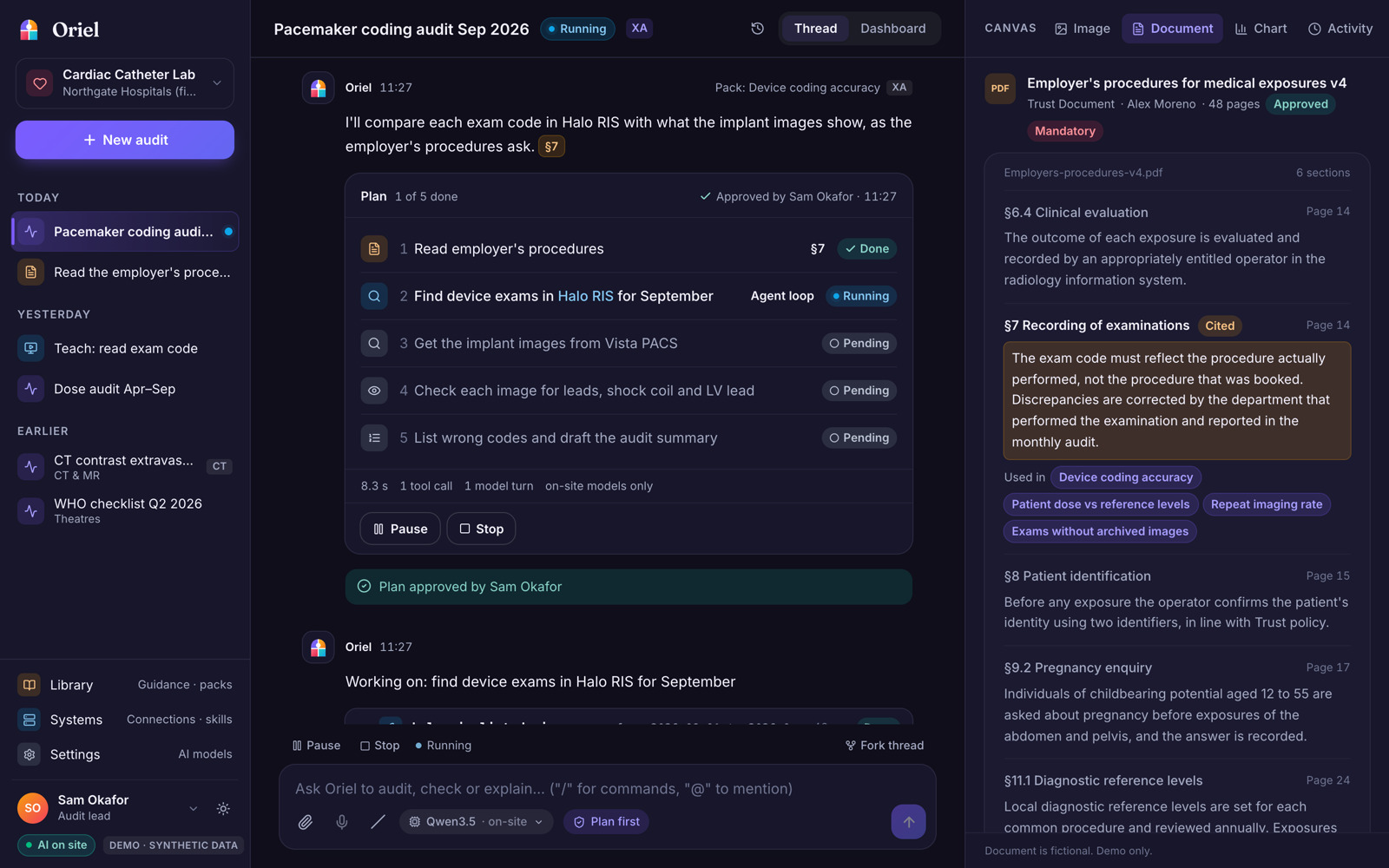 Oriel: On-premises AI clinical auditWatch the demo on synthetic data, then see how it works →
Questions
Who owns a clinical audit action plan?
HQIP's template names an action plan lead, and each action has its own person responsible, recorded by name and grade.
What if an action cannot be done?
Record it at change stage 4 with the reasons, and say why in the report's implementation section.
Should every recommendation have an action?
Every recommendation appears in the plan. If no action is needed, HQIP's template asks you to write "None".
Sources
Official pages, checked November 2026. Guidance changes, so check the current version before you rely on it.
General information for healthcare managers and clinical teams, checked November 2026. It is not legal, regulatory or clinical advice; follow the current official guidance and your organisation's own policies. No patient data is used in these examples. Oriel is a working prototype shown on a fictional demo hospital with synthetic data only. It is not a medical device and is not for clinical use. It drafts and flags for people to decide; it does not diagnose or change clinical records. A clinical safety case and information-governance approval come before any use with real patient data. Oriel is a working name.