
Guide · checked November 2026
Clinical audit examples for hospital, nursing, pharmacy and radiology
A good clinical audit example has one shape: a topic with a known risk, a criterion taken from a national standard (such as NICE's 24-hour medicines reconciliation in hospital), a target, a defined set of cases and a data source that can answer the question.
How to read these examples
Each example below is an outline you could register, not a finished report. The standards are taken from the published guidance; check the current version before you use them. We have not included results. Compliance depends on your service, and HQIP points out that percentages mean little without the sample size behind them.
Hospital: keeping surgical patients warm
- Criteria: temperature documented in the hour before leaving the ward; temperature 36.0°C or above at induction.
- Cases: adults on elective theatre lists over a set period.
- Data sources: ward observations and the anaesthetic record.
- Watch for: define the urgent-surgery exception before you collect, not after.
NICE CG65 says an adult's temperature should be measured and documented in the hour before they leave the ward or emergency department for surgery, and that induction of anaesthesia should not begin unless their temperature is 36.0°C or above, unless surgery has to be expedited because of clinical urgency.
Nursing: pressure ulcer risk assessment
- Criterion: risk assessment recorded within 6 hours of admission.
- Cases: admissions to the selected wards over a month.
- Data sources: nursing admission documentation or the electronic record.
- Watch for: say in the protocol which time counts as admission, so every collector measures from the same point.
Statement 1 of NICE's pressure ulcer quality standard (QS89) is that people admitted to hospital or a care home with nursing have a pressure ulcer risk assessment within 6 hours of admission.
Pharmacy: medicines reconciliation
- Criterion: reconciliation completed within 24 hours of admission.
- Cases: adult admissions over a set period.
- Data sources: admission time from the patient administration system and the pharmacy record.
- Watch for: NICE notes reconciliation may be needed again on transfer or discharge, so say whether you are measuring admission only.
NICE NG5 recommends that, in an acute setting, medicines reconciliation is carried out within 24 hours, or sooner if clinically necessary, when a person moves from one care setting to another, for example on admission to hospital.
Radiology: justification and reporting
- Criterion: every exam in the period has a report (clinical evaluation) on the system.
- Cases: all exams in a modality over a month.
- Data sources: the RIS for exams performed and reports issued.
- Watch for: reconcile the two lists by accession number rather than counting each separately.
IR(ME)R 2017 requires the employer's procedures to provide for clinical audit of medical exposures. Common local topics include whether each exposure was justified and authorised before it happened and whether every exam has a recorded clinical evaluation. The Royal College of Radiologists' AuditLive collection has audit templates covering over 100 radiology topics, supporting the Quality Standard for Imaging.
What the findings usually look like
HQIP's report template asks you to state N, highlight each standard, and give the number and percentage that met it, explaining exceptions and any non-compliance. Observations are split into good practice and areas for improvement, with root causes where they are known. Clinicians, wards and sites appear only as codes.
Using examples well
- An example audit is not evidence about your service: run it on your own cases.
- Copying another trust's target without agreeing it locally. HQIP asks for thresholds to be agreed by the multidisciplinary team.
- Choosing a topic because the data is easy to get, rather than because care could improve.
Where Oriel fits
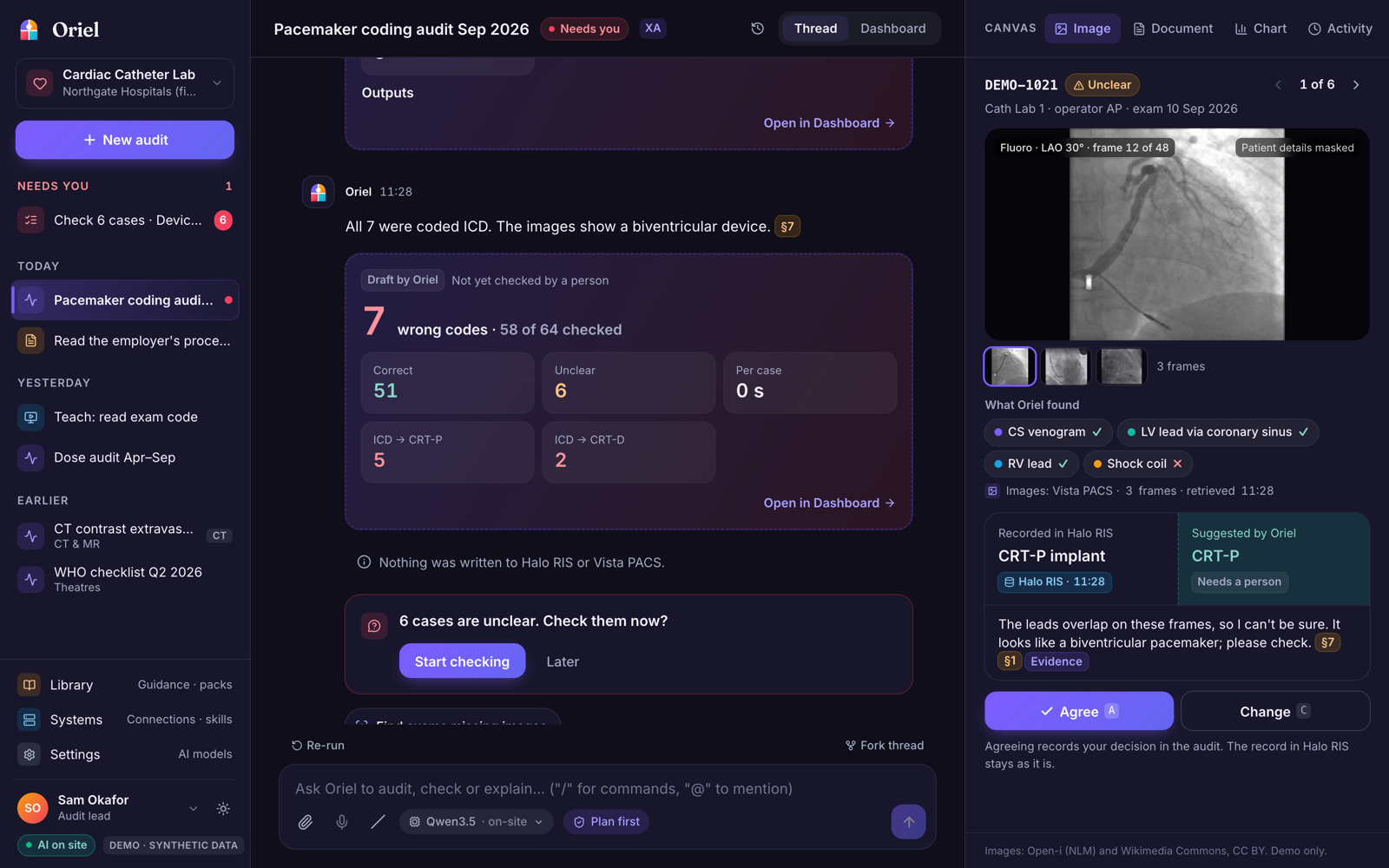
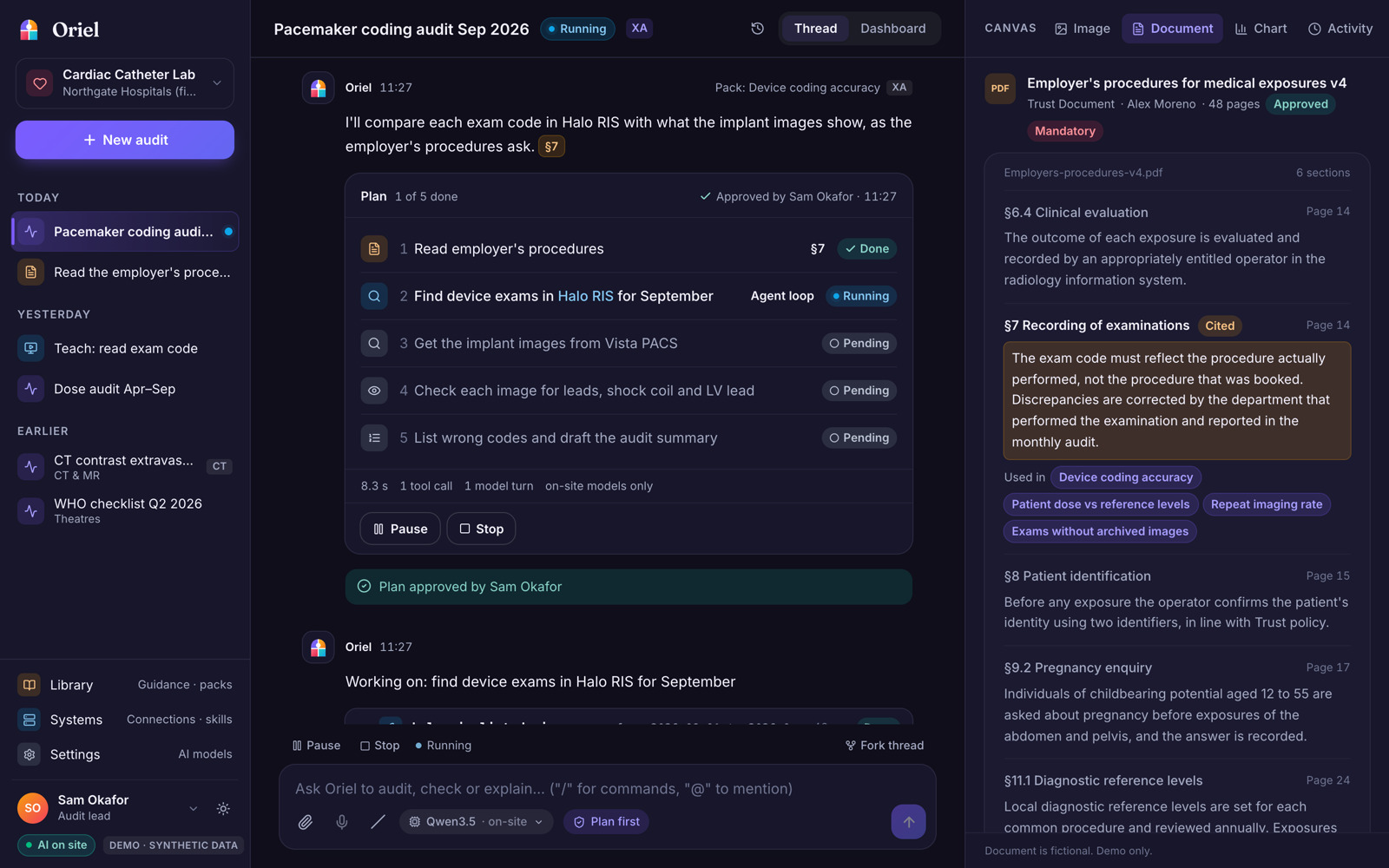
Oriel's demo hospital includes audits of this shape: pacemaker device coding and radiation dose in the cath lab, imaging exams without archived images, pathology turnaround breaches, controlled drug witnessing in pharmacy, and research. Its standards library describes typical checks, such as medicines reconciliation within 24 hours under NICE NG5 and all three stages of the WHO Surgical Safety Checklist.
Each case is shown with its evidence and a suggested finding that a named person agrees or changes. Oriel is a pilot on synthetic data only.
 Oriel: On-premises AI clinical auditWatch the demo on synthetic data, then see how it works →
Questions
What is a simple clinical audit to start with?
One criterion, one ward or clinic, one period, with the data already in the record. A timed standard such as a risk assessment within 6 hours of admission is easy to measure and easy to repeat.
Where can I find radiology audit examples?
The Royal College of Radiologists' AuditLive collection has templates covering over 100 radiology topics, supporting the Quality Standard for Imaging.
Should my report include results from other trusts?
Only published, referenced figures, as context. Your report should state your own N and compliance against your own target.
Sources
Official pages, checked November 2026. Guidance changes, so check the current version before you rely on it.
- NICE: CG65 Hypothermia, prevention and management in adults having surgery (recommendations)
- NICE: QS89 Pressure ulcers, quality statements
- NICE: NG5 Medicines optimisation (recommendations)
- Royal College of Radiologists: AuditLive radiology templates
- HQIP: Documenting local clinical audit, a guide to reporting and recording (April 2020)
General information for healthcare managers and clinical teams, checked November 2026. It is not legal, regulatory or clinical advice; follow the current official guidance and your organisation's own policies. No patient data is used in these examples. Oriel is a working prototype shown on a fictional demo hospital with synthetic data only. It is not a medical device and is not for clinical use. It drafts and flags for people to decide; it does not diagnose or change clinical records. A clinical safety case and information-governance approval come before any use with real patient data. Oriel is a working name.