
Guide · checked November 2026
Clinical audit in nursing: topics, standards and examples
Clinical audit in nursing measures nursing care against a published standard, such as NEWS2 observations and escalation, NICE's pressure ulcer quality standard or NICE's 2025 falls guideline, then acts on the gap and measures again; it follows the same four-stage cycle HQIP sets out for any clinical audit.
Why nursing care suits audit
Much nursing care is recorded as timed, structured entries: observation charts, risk assessments and care plans. That makes it countable. HQIP uses "clinician" to mean clinical professionals and staff of all grades, so nurses can lead audits in their own right.
HQIP's guide to analysing improvement data uses nursing examples to explain sampling: a documentation audit of a district nurse's caseload of 1,500 patients, where taking every 15th patient after a random start gives a sample of 100, and a hand-washing audit stratified across healthcare assistants and nurses with different levels of infection control training.
Deterioration: NEWS2
- Criterion: every observation set has all parameters recorded.
- Criterion: the aggregate score is calculated correctly.
- Criterion: escalation followed the trigger thresholds in your local response policy.
The Royal College of Physicians' NEWS2 scores six physiological measurements already recorded in routine practice, adds the scores together and adds two points for people who need supplemental oxygen. New confusion scores 3. NHS England has endorsed NEWS2 as the early warning system for identifying acutely ill patients, including those with sepsis, in hospitals in England.
Pressure ulcers
NICE's pressure ulcer quality standard (QS89) includes these statements: people admitted to hospital or a care home with nursing have a pressure ulcer risk assessment within 6 hours of admission; risk is reassessed after a surgical or interventional procedure or a transfer; people at high risk have a skin assessment; people who cannot reposition themselves are helped to change position; and people at high risk are given pressure redistribution devices. Each statement is a ready-made criterion.
Falls
NICE NG249, published in April 2025, replaced the 2013 falls guideline. It covers everyone aged 65 and over and people aged 50 to 64 at higher risk, and recommends offering a comprehensive falls assessment and comprehensive falls management to people in hospital inpatient settings, with interventions tailored to each person's risk factors and the ward environment, and education they can take part in.
A local audit might measure the proportion of eligible inpatients with a documented multifactorial assessment, and the proportion of those with a plan that addresses the risk factors found.
Running it on a ward
- Agree the standard and the exceptions with the ward team before collecting.
- Use the record as the source, not recollection.
- Decide in advance whether "not documented" counts as not done, and state it as a caveat, as HQIP's report template shows.
- Feed back quickly to the people who give the care, then measure again.
- Refer to wards and staff by code, never by name.
Common pitfalls
- A spot check is not an audit unless it measures against a standard with a defined sample.
- Counting falls or pressure ulcers shows outcomes; auditing the process steps shows why they happen.
- Auditing against a superseded guideline: NICE's falls guidance changed in 2025.
Where Oriel fits
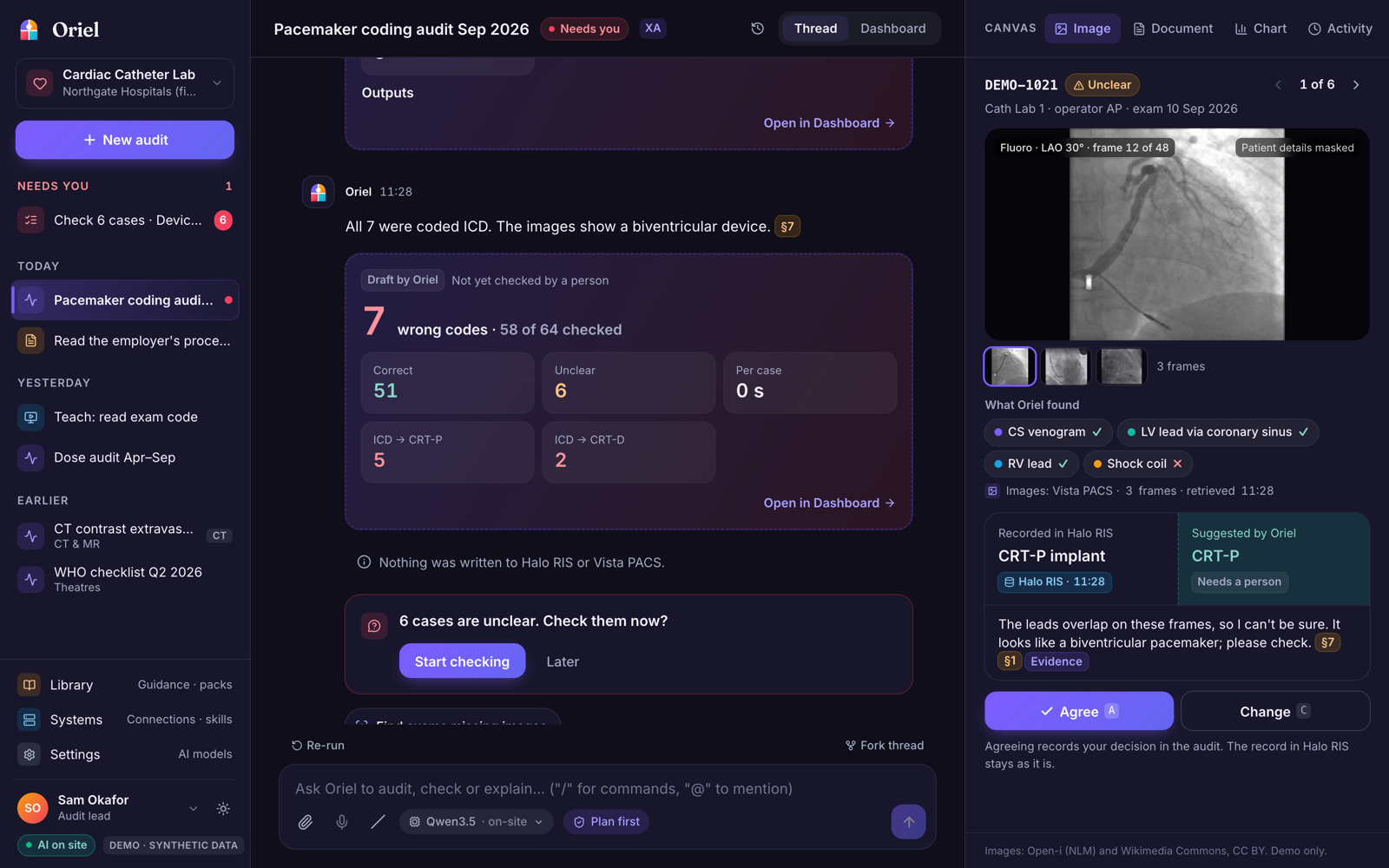
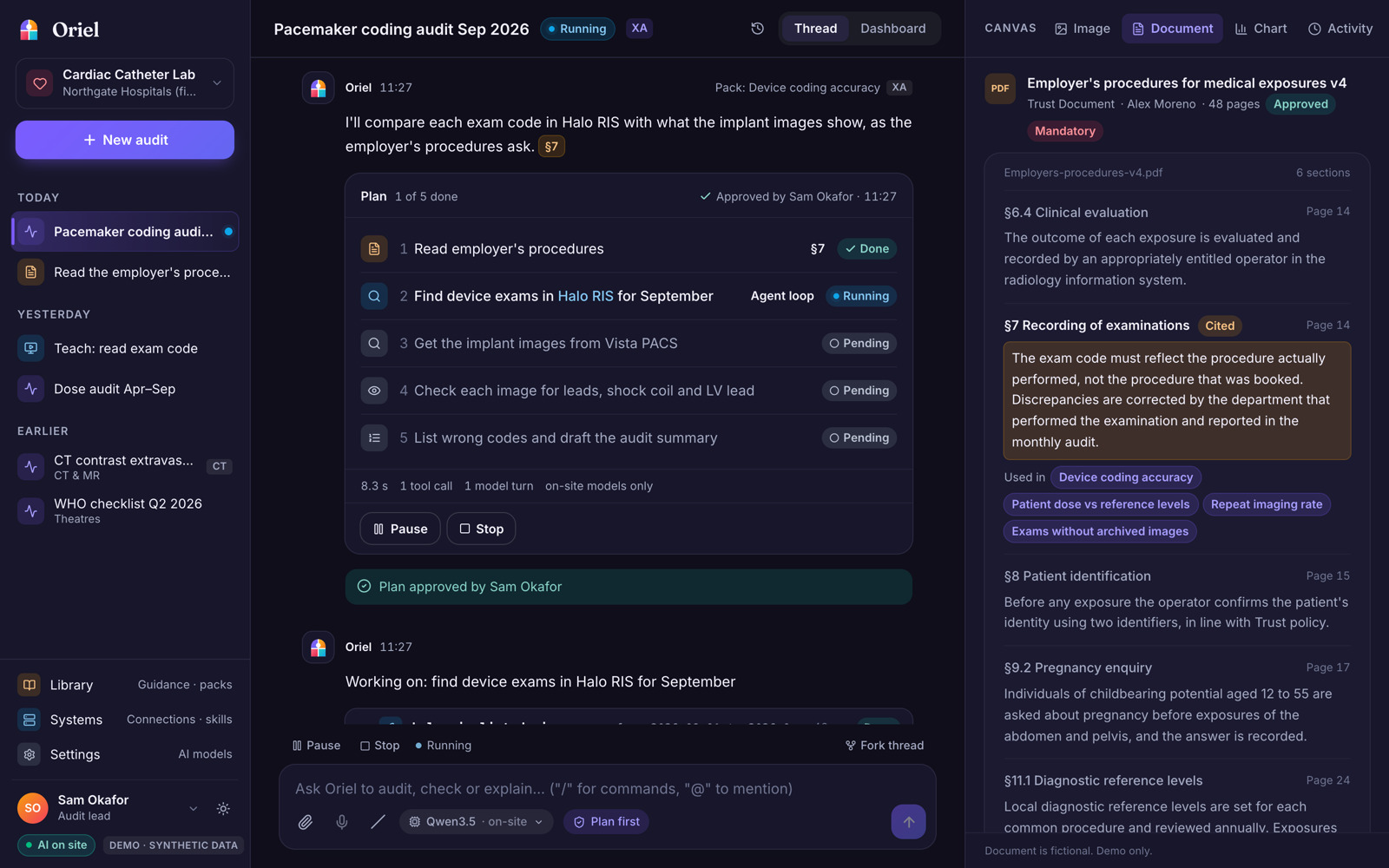
Oriel's demo hospital does not include a nursing audit today. The checks above have the same shape as ones it does run: a timed standard such as a risk assessment within 6 hours of admission is a rule on two timestamps, like the medicines reconciliation within 24 hours in its standards library.
A pack for it would be drafted from a description, approved by governance, and would need a connection to the system that holds the nursing record. Oriel is a pilot shown on synthetic data only and is not a medical device.
 Oriel: On-premises AI clinical auditWatch the demo on synthetic data, then see how it works →
Questions
What are examples of nursing audits?
NEWS2 completeness and escalation, pressure ulcer risk assessment within 6 hours of admission, falls assessment for inpatients, and record-keeping audits.
How often should nursing audits be repeated?
There is no single interval. HQIP leaves it to the audit's stakeholder group, which can also choose ongoing monitoring instead of a formal re-audit.
Can a nurse lead a clinical audit?
Yes. HQIP uses "clinician" to cover clinical professionals and staff of all grades.
Sources
Official pages, checked November 2026. Guidance changes, so check the current version before you rely on it.
- Royal College of Physicians: National Early Warning Score (NEWS2)
- NICE: QS89 Pressure ulcers, quality statements
- NICE: NG249 Falls, assessment and prevention (recommendations, 2025)
- HQIP: An introduction to analysing quality improvement and assurance data (October 2018)
- HQIP: Best practice in clinical audit (April 2020)
General information for healthcare managers and clinical teams, checked November 2026. It is not legal, regulatory or clinical advice; follow the current official guidance and your organisation's own policies. No patient data is used in these examples. Oriel is a working prototype shown on a fictional demo hospital with synthetic data only. It is not a medical device and is not for clinical use. It drafts and flags for people to decide; it does not diagnose or change clinical records. A clinical safety case and information-governance approval come before any use with real patient data. Oriel is a working name.