
Guide · checked November 2026
Clinical audit topics by specialty, and how to choose one
Choose a clinical audit topic where there is a clear national standard, a known risk or local concern, and someone ready to act on the result; HQIP lists clinical risks and incidents, organisational, patient and commissioner priorities, national audit outputs and revalidation needs as the factors to weigh.
How to pick a topic
HQIP's Best practice in clinical audit (2020) asks that every project is first reviewed to check the topic can be improved and that audit is the most suitable method. A practical test: can you name the standard, count the eligible cases, and say who will change what if compliance is low? If not, the topic may suit service evaluation or another improvement method better.
Sharing plans across the organisation also prevents two teams auditing the same thing, which is one reason HQIP gives for registering audits.
Emergency medicine
The Royal College of Emergency Medicine runs a national quality improvement programme open to all type 1 UK emergency departments. Its Care of Older People programme set standards that people aged 75 and over are screened for delirium using the 4AT, assessed for falls risk and screened for frailty, and that action follows: a delirium management plan, a post-fall assessment, a falls mitigation plan and a comprehensive geriatric assessment. A local audit can use the same standards.
Obstetrics and gynaecology
HQIP's own example objective is to check that births after a previous caesarean are managed in line with the national guideline, the RCOG's Green-top Guideline No. 45. The RCOG page says the current edition dates from 2015 and an update is in development, so confirm the version before you write criteria.
Anaesthesia and theatres
NICE CG65 on inadvertent perioperative hypothermia gives clear criteria: temperature measured and documented in the hour before leaving the ward, no induction below 36.0°C unless surgery is urgent, and critical incident reporting considered for any patient arriving in theatre below 36.0°C.
Paediatrics
NICE NG143 on fever in under 5s recommends measuring and recording temperature, heart rate, respiratory rate and capillary refill time as part of the routine assessment of a child with fever, and using its traffic light system to assess the risk of serious illness. Whether all four measures are recorded is a clean, countable criterion.
Psychiatry
The Royal College of Psychiatrists' Prescribing Observatory for Mental Health (POMH) runs audit-based quality improvement programmes on mental health prescribing topics, chosen from recommendations by member trusts and partner organisations. Relevance to NICE guidelines and clinical priority are among its selection criteria, and members get reports benchmarked anonymously against other organisations. Re-running a POMH topic locally is a strong choice because the standards and tools already exist.
Intensive care
The Faculty of Intensive Care Medicine and the Intensive Care Society published the third edition of the Guidelines for the Provision of Intensive Care Services (GPICS) in January 2026. Its minimum standards are written as single must-do statements, a format the Intensive Care Society says improves auditability. Pick a standard linked to a local risk or a recent inspection finding.
General and acute medicine
NEWS2, from the Royal College of Physicians, scores six routine physiological measurements, adds two points for supplemental oxygen, and has been endorsed by NHS England as the early warning system for identifying acutely ill patients, including those with sepsis, in hospitals in England. Audit whether observation sets are complete, whether scores are added up correctly and whether escalation followed the trigger thresholds.
Topic traps
- A topic with no standard to measure against is service evaluation, not audit.
- Duplicating a national audit your trust already submits to: check its report first.
- A topic so broad that no one owns the result.
Where Oriel fits
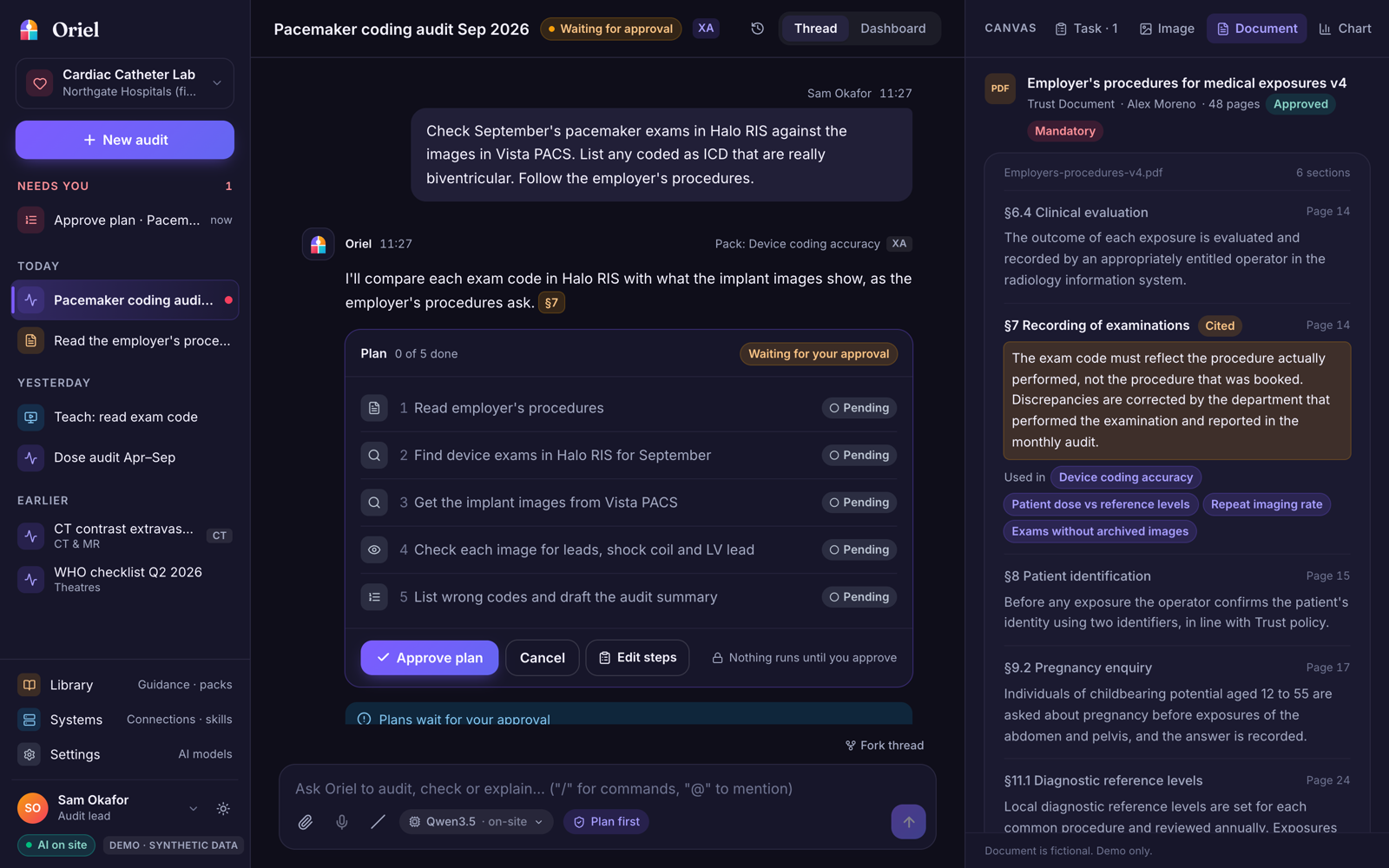
Oriel does not choose topics for you. Once you have one, an audit pack can be drafted from a one-line description or started from a standard in its library, then approved by governance before use. Each run begins with a plan saying what will be read and which part of your procedures applies, and nothing runs until a person approves it.
Oriel is a pilot shown on synthetic data only and is not a medical device.
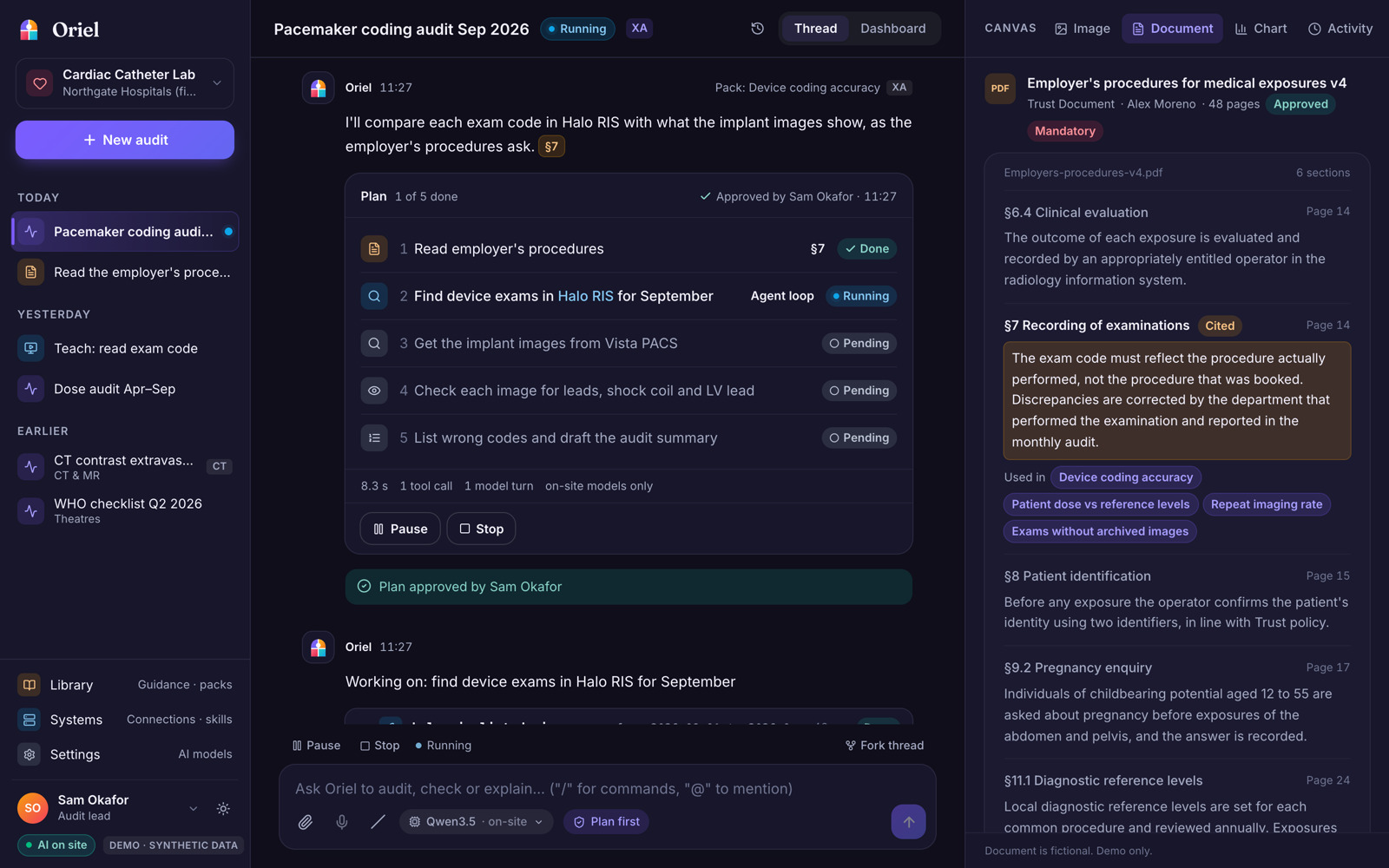 Oriel: On-premises AI clinical auditWatch the demo on synthetic data, then see how it works →
Questions
What makes a good clinical audit topic?
A clear evidence-based standard, cases you can identify and count, a known risk or concern, and a team willing to act on the result.
Can a trainee pick any topic?
It should fit the organisation's audit programme and local policy. HQIP says audits led by doctors on rotation should be overseen by a more senior clinician so they are completed.
Where do I find standards for my specialty?
Start with NICE guidance and quality standards, then your royal college or faculty, which often publish audit standards or national improvement programmes.
Sources
Official pages, checked November 2026. Guidance changes, so check the current version before you rely on it.
- HQIP: Best practice in clinical audit (April 2020)
- RCEM: Care of Older People QIP 2023-24 interim report
- RCOG: Birth after previous caesarean birth (Green-top Guideline No. 45)
- NICE: CG65 Hypothermia, prevention and management in adults having surgery (recommendations)
- NICE: NG143 Fever in under 5s (recommendations)
- Royal College of Psychiatrists: About POMH (Prescribing Observatory for Mental Health)
- Intensive Care Society: GPICS 3rd edition published (with FICM)
- Royal College of Physicians: National Early Warning Score (NEWS2)
General information for healthcare managers and clinical teams, checked November 2026. It is not legal, regulatory or clinical advice; follow the current official guidance and your organisation's own policies. No patient data is used in these examples. Oriel is a working prototype shown on a fictional demo hospital with synthetic data only. It is not a medical device and is not for clinical use. It drafts and flags for people to decide; it does not diagnose or change clinical records. A clinical safety case and information-governance approval come before any use with real patient data. Oriel is a working name.